
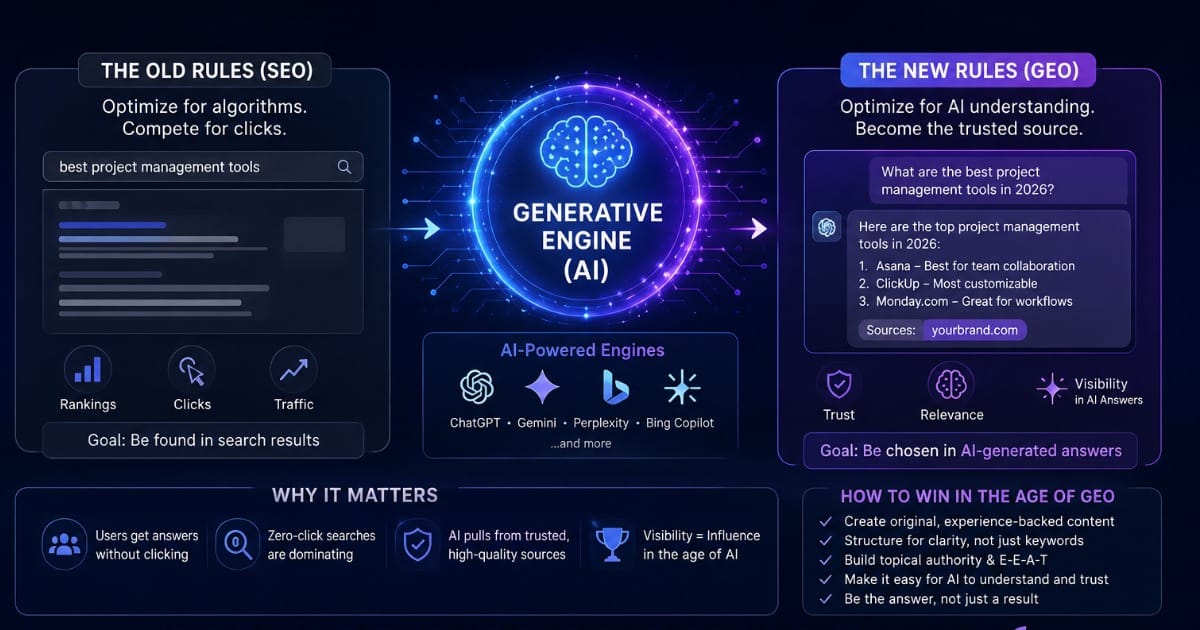
If you’ve noticed your website traffic behaving strangely lately — impressions climbing while clicks stay flat, or your brand being mentioned in AI answers you never optimised for — you’re not imagining things. Search has fundamentally changed, and Generative Engine Optimization is at the centre of that shift.
This guide breaks down exactly what GEO is, how it differs from traditional SEO, and what you can do right now to stay visible in a world where AI answers questions before users ever visit a website.
What Is GEO and Why Everyone’s Talking About It
Generative Engine Optimisation is the practice of optimising your content so that AI-powered search engines and large language models (LLMs) understand, trust, and cite your brand in their generated responses.
Think about how you used Google five years ago. You typed a query, scanned ten blue links, and clicked the one that looked most relevant. That behaviour is rapidly disappearing.
Today, tools like ChatGPT, Google’s AI Overviews, Perplexity AI, and Gemini are doing something fundamentally different. They read across thousands of sources, synthesise the information, and deliver a single confident answer — often without the user ever clicking through to a website. According to recent industry data, AI-driven summaries are now answering the majority of informational queries before a user visits any page.
This creates a new challenge for businesses. Your content might be ranking on page one of Google and still be completely invisible inside an AI-generated answer. That’s the gap Generative Engine Optimization is designed to close.
The core difference is this: Traditional SEO optimises your content for algorithmic ranking signals — backlinks, keywords, technical structure. GEO optimises your content for machine comprehension — how clearly an AI model can read, interpret, and confidently cite what you’ve written.
These are related disciplines, but they are not the same thing. And in 2026, you need both.
Is Traditional SEO Dead? (Spoiler: Not Quite)
Every few years, someone declares SEO dead. It never is. But it is changing — sometimes gradually, sometimes dramatically. Right now, we’re in a dramatic period.
Traditional SEO is still very much alive and delivering results in specific areas:
Local search remains largely algorithm-driven. When someone searches “digital marketing agency near me” or “best restaurant in Delhi,” Google still returns local pack results powered by proximity, reviews, and Google Business Profile signals. GEO plays almost no role here yet.
Branded queries — people searching directly for your business name — continue to be influenced by classic SEO factors like your website authority, review signals, and Knowledge Panel presence.
Transactional intent searches, where someone is ready to buy, still heavily feature paid ads and organic blue links because users want to compare options, not receive a summarised answer.
Where traditional SEO is genuinely struggling is with informational and top-of-funnel content. Questions like “what is the best CRM for a small business” or “how does Google Ads bidding work” are increasingly answered entirely within an AI Overview or a Perplexity response. Users get their answer and move on. The click never happens.
This is where Generative Engine Optimization becomes essential. If you’re producing informational content to build awareness and authority, you need to optimise it for AI citation — not just for traditional ranking.
The smart position in 2026 is not to choose between SEO and GEO. It’s to understand which type of query calls for which approach, and build a strategy that addresses both.
How GEO Works: The Key Ranking Factors
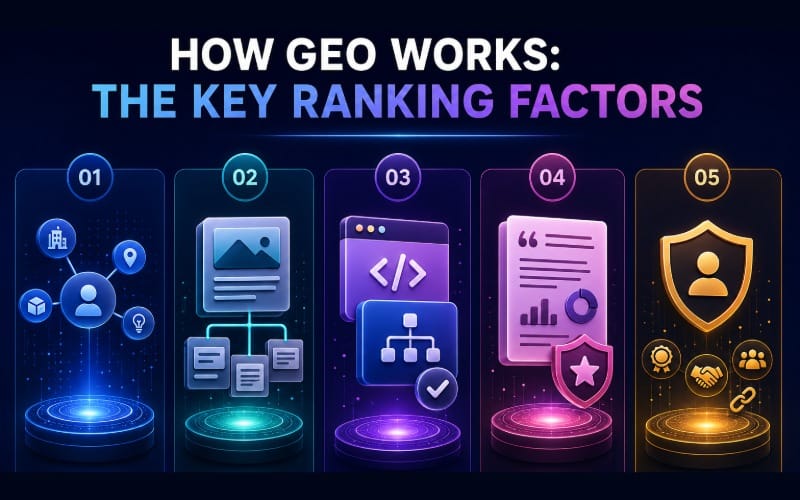
Generative Engine Optimization doesn’t have an official algorithm the way Google Search does. But through extensive testing and observation, a clear set of factors has emerged that determines whether an AI model cites your content or ignores it entirely.
Entity Clarity
AI models think in entities — named people, places, organisations, products, and concepts. The clearer you make your content about who you are, what you do, and what specific topics you are authoritative on, the more likely an LLM is to associate your brand with those topics. Vague, generalised content rarely gets cited. Specific, clearly attributed content does.
Topical Authority
LLMs favour sources that have demonstrated comprehensive coverage of a subject. A website that has published ten in-depth, interconnected articles on e-commerce SEO will almost always outperform a website that has one average blog post on the topic — even if that single post is technically well optimised. Building topical authority through pillar and cluster content is now a GEO signal as much as an SEO one.
Structured Data and Semantic Markup
Schema markup helps AI models understand the context of your content faster and with greater confidence. FAQ schema, How-To schema, and Article schema are particularly effective at making your content machine-readable in a way that supports GEO visibility.
Citation-Worthy Content
AI models are trained to cite sources that contain original data, clear expert opinions, direct quotes, specific statistics, and well-structured factual claims. Content that hedges, over-qualifies, or avoids clear statements is much less likely to be cited. Write with confidence and back your claims with evidence.
EEAT Signals
Experience, Expertise, Authoritativeness, and Trustworthiness were already central to traditional SEO quality assessment. In GEO, they are even more critical. LLMs are designed to prioritise credible, trustworthy sources. Clear author credentials, transparent business information, third-party mentions, and a strong backlink profile all feed into how trustworthy an AI model considers your content to be.
Five Practical GEO Tactics You Can Apply Today
Understanding the theory behind Generative Engine Optimization is one thing. Putting it into practice is another. Here are five tactics you can start implementing immediately.
Tactic 1 — Build a Pillar and Cluster Content Architecture
Choose three to five core topics that define your business. Create one comprehensive pillar page for each topic and support it with eight to twelve cluster articles that address specific subtopics in depth. Link them together deliberately. This architecture signals topical authority to both Google and AI models, making you the go-to source on those subjects.
Tactic 2 — Add FAQ Schema to Every Key Page
AI Overviews and conversational AI tools love FAQ-style content because it maps directly to how users ask questions. Adding properly structured FAQ schema to your service pages, blog posts, and landing pages increases the likelihood of your content being surfaced in AI-generated answers. Write your questions the way real people speak, not the way you think they should ask.
Tactic 3 — Write in a Conversational, Direct Style
LLMs are trained on natural language. Content that is formal to the point of being robotic, or that buries its key points in jargon, is harder for AI models to extract and summarise. Write clearly. Make your key claims early in each section. Use plain language without dumbing things down. Think of every paragraph as something that should be quotable on its own.
Tactic 4 — Cite Your Sources and Include Original Data
One of the strongest signals that makes content citation-worthy is having something genuinely worth citing. Include original research, client data (anonymised where needed), proprietary frameworks, or clear expert analysis. When you reference statistics, cite the original source. This builds credibility with both human readers and AI systems evaluating your content’s reliability.
Tactic 5 — Build Your Branded Entity
Make sure your brand appears consistently across the web as a recognised entity. This means maintaining an up-to-date Google Business Profile, having a well-structured Wikipedia-style About page, being mentioned on credible industry sites, and ensuring your brand name, description, and key information are consistent everywhere they appear. The more clearly defined your entity is, the more confidently AI models will reference you.
Measuring GEO Success: New KPIs to Track
One of the most common questions we hear is: how do I know if my Generative Engine Optimization efforts are working?
Traditional SEO metrics — rankings, organic traffic, click-through rate — don’t tell the full story anymore. When an AI Overview answers a user’s question using your content, you might earn massive brand exposure without a single click being recorded in Google Analytics. Your old KPIs will make it look like nothing is happening, when actually something very significant is.
Here are the metrics that matter for GEO in 2026:
AI Citation Tracking — Tools like Brandwatch, Mention, and dedicated GEO monitoring platforms now allow you to track when your brand or content is cited inside AI-generated answers across ChatGPT, Perplexity, Google AI Overviews, and others. This is your primary GEO performance indicator.
Branded Search Volume — If your GEO strategy is working, more people will be discovering your brand through AI answers and then searching for you directly. Monitor your branded query volume in Google Search Console over time. A steady upward trend is one of the clearest signs of growing GEO visibility.
Impression-to-Click Ratio in Search Console — As AI Overviews absorb more informational clicks, you’ll often see impressions rising while clicks remain flat or fall. Rather than treating this as a failure, track it as a signal of how much of your content is being consumed inside AI-generated results rather than through direct visits.
Direct Traffic Growth — Users who discover your brand through an AI answer and return to your website later typically arrive as direct traffic. Monitoring this channel alongside your other GEO metrics gives you a more complete picture of AI-driven demand generation.
Share of Voice in AI Results — Run regular manual tests by asking AI tools the key questions in your industry and recording which brands are cited most frequently. Track your share of voice over time as your GEO optimization efforts compound.
The Integrated Strategy — Running SEO and GEO Together
The biggest mistake businesses are making right now is treating SEO and Generative Engine Optimization as separate workstreams with separate budgets and separate teams. They are not competing disciplines. They are two layers of the same visibility strategy.
The good news is that most of what makes content perform well in traditional SEO also makes it perform well in GEO. Strong topical authority, clear structure, genuine expertise, comprehensive coverage, technical soundness — all of these serve both goals simultaneously.
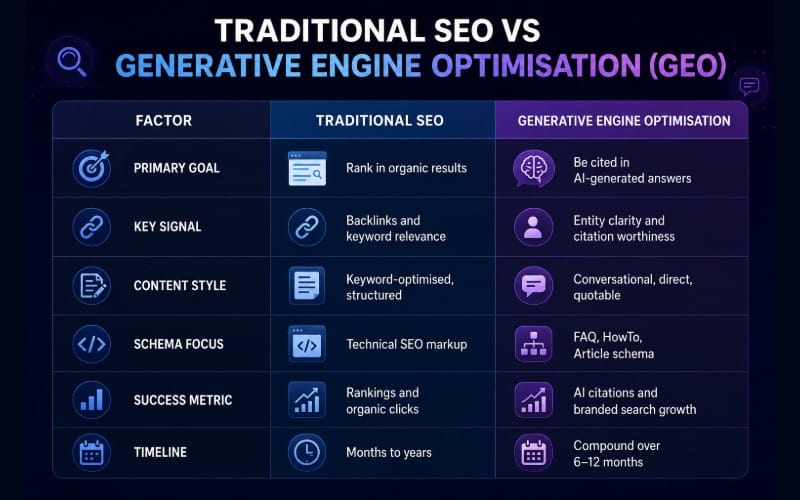
The difference lies in emphasis and execution. GEO asks you to write with AI comprehension in mind. It asks you to be more direct, more cited, more entity-clear, and more conversational than traditional SEO content often required.
Here’s a practical way to think about the integration:
| Factor | Traditional SEO | Generative Engine Optimization |
|---|---|---|
| Primary goal | Rank in organic results | Be cited in AI-generated answers |
| Key signal | Backlinks and keyword relevance | Entity clarity and citation worthiness |
| Content style | Keyword-optimised, structured | Conversational, direct, quotable |
| Schema focus | Technical SEO markup | FAQ, HowTo, Article schema |
| Success metric | Rankings and organic clicks | AI citations and branded search growth |
| Timeline | Months to years | Compound over 6–12 months |
The brands that will win in search over the next three years are the ones building content ecosystems that satisfy both layers at once. That means publishing with depth, demonstrating genuine expertise, structuring information clearly, and ensuring their brand is recognised and trusted across both algorithmic and AI-driven discovery.
Generative Engine Optimization is not a replacement for what you’ve already built. It’s the next layer on top of it. Start building that layer now, before your competitors do.
Conclusion
Search has changed. That is just the reality of 2026.
But here is the thing — the brands winning in AI search are not doing anything magical. They are simply doing the basics better than everyone else. Clear writing, genuine expertise, structured content, and consistent authority building. GEO rewards exactly those qualities.
You do not need to abandon everything you know about SEO. You just need to add a smarter layer on top of it.
At Performa DigiTech Solutions, the best SEO agency in Dehradun, we help businesses build content strategies that work across both traditional search and AI-powered platforms. Whether you are just getting started or looking to take your existing SEO to the next level, we are here to help you stay visible — no matter how search evolves.
The future belongs to brands worth citing. Let us help you become one.
Frequently Asked Questions
What is Generative Engine Optimization in simple terms?
GEO is about making your content easy for AI tools like ChatGPT, Google AI Overviews, and Perplexity to understand and reference in their answers. Instead of just ranking on Google, you are getting cited inside AI-generated responses — which is where a huge chunk of search is heading.
Is GEO replacing SEO?
No, and anyone telling you it is — is oversimplifying things. SEO still works brilliantly for local search, branded queries, and transactional intent. GEO fills the gap where AI tools are now answering informational questions before users ever click a link. You need both working together.
How long does GEO take to show results?
Realistically, six to twelve months of consistent effort before you see meaningful shifts in AI citation frequency and branded search growth. It compounds over time, just like SEO does. There are no shortcuts here — but the brands that start now will have a serious head start.
Do I need a big budget to get started?
Not at all. The highest-impact GEO tactics — better content structure, FAQ schema, cleaner writing, stronger internal linking — are more about strategy than spending. Budget helps when you want to scale faster or invest in citation monitoring tools, but you can make meaningful progress without a massive investment.
What content gets cited most by AI tools?
Specific, well-structured, and genuinely useful content. FAQs, how-to guides, comparison pieces, and original data tend to get cited far more than generic overviews. Write like a real expert talking to a real person, not like someone trying to please an algorithm.
How do I track if AI tools are citing my content?
Start manually — type your target questions into ChatGPT, Perplexity, and Google AI Overviews and see what comes up. For ongoing tracking, tools like Brandwatch and Mention can monitor brand citations across AI platforms automatically.
Is EEAT still important for GEO?
More than ever. AI models are built to prioritise credible, expert sources. Clear author bios, real business information, third-party mentions, and a strong backlink profile all signal to AI tools that your content is worth citing. EEAT is the foundation everything else sits on.